
Mobile Previous Residents Sources
One Mobile address may pass through several record eras. Present parcel data supplies the stable starting key. Deeds carry owners backward. Directories and census schedules can add people who appear at the address on a given date. Permits, maps, newspapers, probate files, and obituaries explain changes or close a person's trail.
| Source | Years covered | Mobile access point | Evidence at the address |
|---|---|---|---|
| Land and deed index | 1813 to present; modern index from 1984 | Probate / Landmark WEB | Transfers, named parties, book and page |
| Document images | Online from September 1995; earlier varies | Landmark or Probate Records Room | Instrument terms and legal description |
| Mobile city directories | From 1837; gaps by holding | Mobile Public Library and ADAH | Dated occupants, address and other entry details |
| Federal census | Public schedules through 1950 | NARA, library and affiliate access | People grouped in a household at census time |
| Permits and code cases | Coverage not verified online | Build Mobile CSS or office | Site work, project, owner or applicant evidence |
| Probate and newspapers | Probate from 1813; papers from 1819 | Probate and Mobile Public Library | Heirs, death, relatives and later events |
Start with the newest reliable source and move back in small steps. A table row is not a promise that every year survives. Mobile Public Library has not published a complete year-by-year directory shelf list, and early document images may need an office visit.
Trace Mobile Previous Owners Backward
The deed chain begins with today's parcel, not a surname. Search the Mobile County Revenue Commission roll by street number and name. Keep its parcel identifier and legal description separate from the situs address. Then use the buyer and seller roles in Mobile County Probate records to work backward from transfer to transfer.
- Copy the present owner's name, parcel number, legal description, and situs address from the property roll.
- Find that owner's purchase in Landmark WEB. Record the instrument, book and page, date, grantee, and grantor.
- Search the seller as a grantee. That earlier purchase should name the next prior seller.
- Repeat the search, checking spelling variants and keeping each transfer tied to the same parcel or legal description.
- When an older index hit has no web image, use the second-floor Records Room at 151 Government Street during weekday hours.
Landmark's index is free to search. Images cost $0.10 per page and remain available to print or download for ten days; the high-volume plan is $125 a month. These fees apply to image access, not to the validity of the index result.
- Grantor and grantee
- The grantor transfers the interest; the grantee receives it.
- Chain of title
- The linked sequence of recorded transfers for one parcel.
- Legal description
- The lot, block, subdivision, metes-and-bounds, or other land wording that identifies the property apart from its street number.
- Criss-cross directory
- A directory arranged by address, useful for turning a known place into a dated occupant listing.
Mobile Probate's Attic Records Story
Mobile County Probate describes a deep record spine. Real-property material begins in 1813, deed books run from 1813 through 1958, and later real-property books continue from 1958. Maps begin in 1872. Judicial indexes start in 1965, judicial images in 1995, and will images in 1997. Those series can connect a transfer to an estate, will, heir, or mapped lot.
The Probate historical records inventory also names public terminals and archive holdings. It is the source for the older access route shown below.
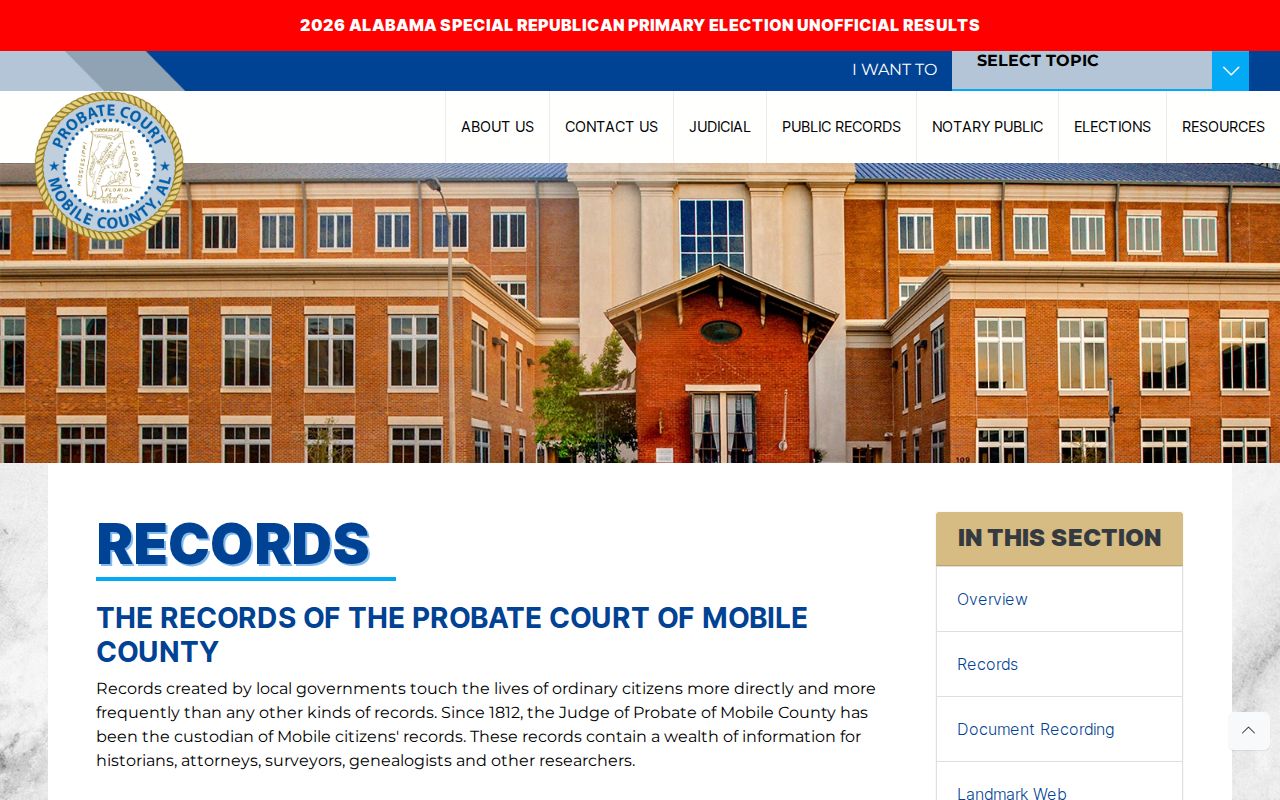
The captured inventory helps separate a series that can be searched online from one that may need a terminal, digitized microfilm, or records-room assistance.
A notable part of Mobile's record history began when staff found colonial and historical material in the courthouse attic. That discovery led to a Probate Archives Section in 1989. It helps explain why many unusual registers and early books survived outside the familiar deed sequence.
Decode Mobile Previous Deed Indexes
The 1813 through 1983 courtesy index has its own rules. Search requires a name and a choice of Grantor, Grantee, or Both. A date range is optional and uses a two-digit year. Years 00 through 12 mean 1900 through 1912, and 84 through 99 mean 1884 through 1899. A value from 13 through 83 may point to either century.
The official historical index instructions show how names, roles, neighboring index entries, and book prefixes fit together.
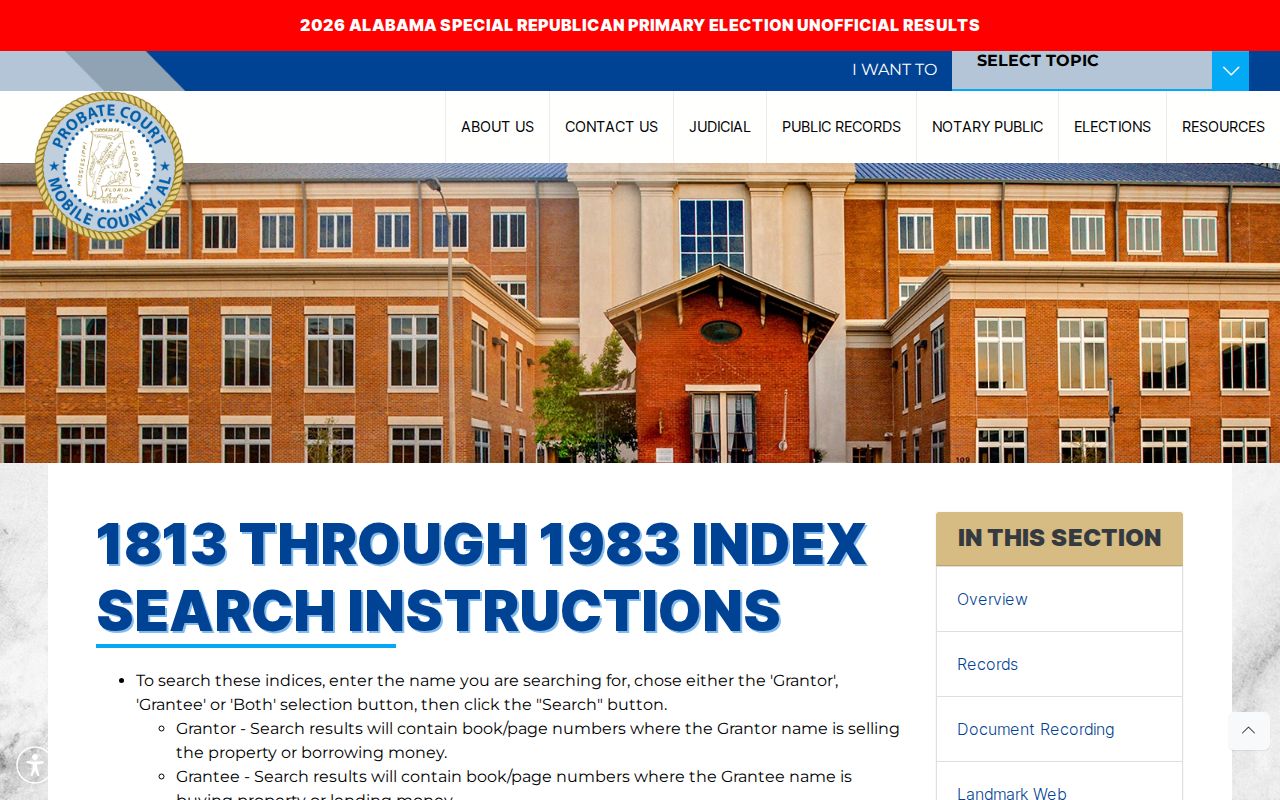
The captured instructions are essential when a short year or old book code could otherwise send the previous-residents trail into the wrong century.
Lettered image names indicate 1813 through 1958, while numeric-only names indicate 1958 through 1983. No-prefix books are from September 1958 or later. Search spelling variants, since Probate warns that inconsistent spelling appears in old indexes. The courtesy index guides the search, but the official recorded instrument controls.
Note: An online index hit may be real even when the document image is unavailable on the web.
Match Mobile Past Residents by Year
Ownership is only one layer. The Mobile Public Library Local History & Genealogy collection holds city directories back to 1837, plus telephone books, yearbooks, newspapers, maps, church material, death and burial sources, and other local records. A reverse section can turn a known address into a listed occupant. An alphabetical section can confirm that person's address and other printed details for the same edition.
- Choose the directory edition closest to a known deed, permit, census, or death date.
- Search the address in the street section when available, then check each listed surname in the alphabetical section.
- Repeat in adjacent editions. Mark the first appearance, last appearance, spelling changes, and any shift in street number.
- Compare the 1940 or 1950 directory result with the corresponding released federal census schedule.
- Use newspapers, death material, probate, and later deeds when a person disappears from the address.
The federal census keeps population schedules confidential for 72 years. In 2026, the 1950 census is the latest public schedule, and the 1960 schedule is due in 2032. A directory entry between census years can bridge the gap, but it should not be read as a full household list.
The directory collections themselves are detailed on the Mobile city directories page. For prior-address work, the key task is to compare dates rather than rebuild the full shelf inventory.
Keep Mobile Address History Stable
A street number can fail as the trail moves back. A road may be renamed or renumbered. The parcel may have entered the city through annexation, while its postal Mobile label stayed the same. The same delivery name can also describe land outside the municipal limit. Legal description, parcel identity, subdivision plat, and lot-and-block wording are stronger bridges.
Mobile Public Library maps, the City Atlas of Mobile in its digital collections, and item-level Sanborn material can help compare names, footprints, and uses. Exact Sanborn edition years were not confirmed in the research, so verify the item before stating a date. Build Mobile permits and code cases may add a project or applicant, though the public CSS fields and coverage were not text-accessible.
Historic districts and dense old wards may require nineteenth-century directories and atlas evidence. Western and southwestern growth areas lean more on plats, modern parcel mapping, and annexation context. This local geography is why an address search should preserve both the old wording and the current parcel key.
Close Mobile Previous Residents Trails
When a name vanishes from the address, Mobile newspapers can supply relatives, clubs, business ties, funeral notices, and a terminal date. The Local History & Genealogy Library has Mobile newspaper microfilm beginning in 1819 and the Mobile Beacon beginning in 1959. Readers can print, email, or scan microfilm images. Probate wills, estate material, and later deeds can then connect named heirs or successors to the parcel.
Municipal Archives cemetery holdings offer another narrow route. Burial reports span stated runs from 1920 through 1973 and may show name, sex, age, race, cemetery, and mortuary. Earlier Parks and Cemetery material includes burial permits, death certificates, a Magnolia deed index, lot-sale records, and purchaser registers. Access depends on the specific series and processing status.
Federal dockets may sometimes explain a later legal event tied to a named former owner. The official PACER source is the federal access channel represented below.
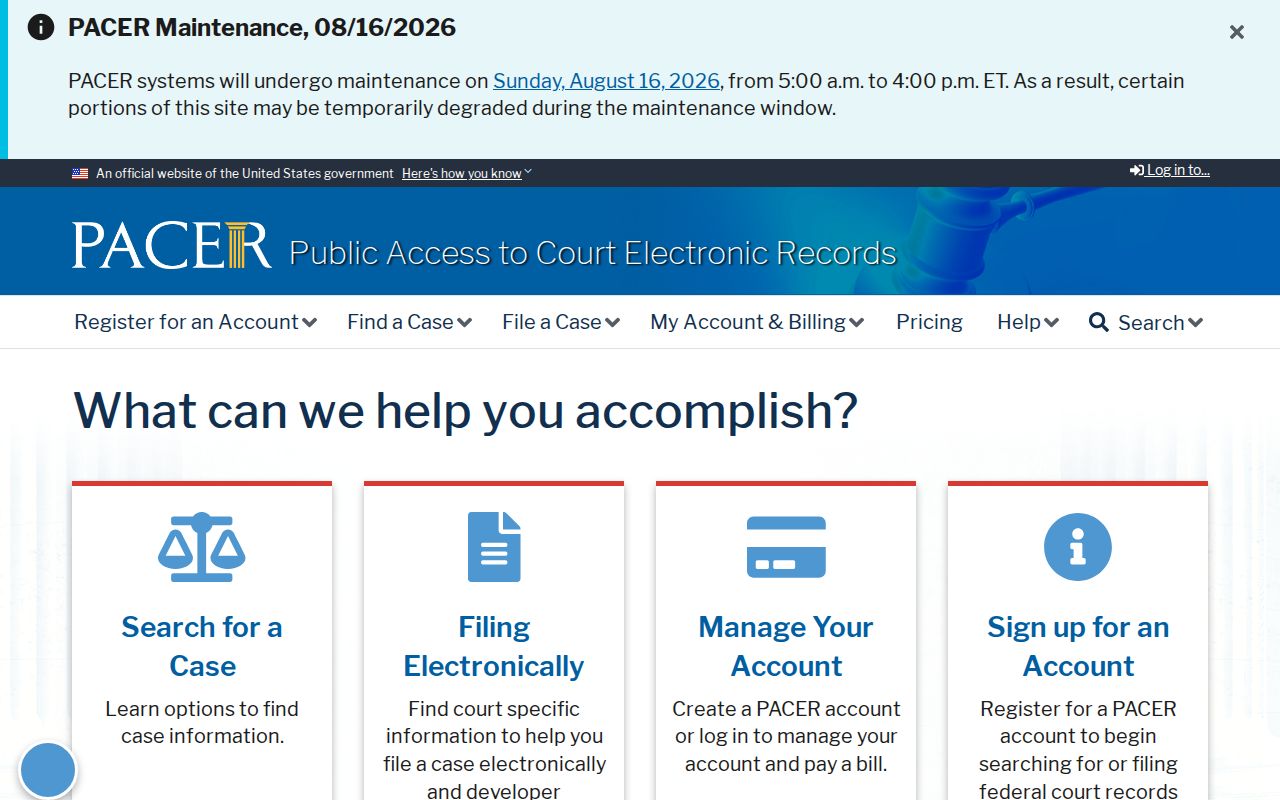
The federal search is a secondary endpoint, not proof of residence. Use it only after an independently verified name and date connect the person to the Mobile address.
Unusual Mobile Past Resident Records
Some Mobile past residents appear in records far outside the standard path. Probate holdings include a naturalization index from 1833 through 1871, a voter oath book from 1870 through 1874, women's voter lists from 1920 through 1921, dog licenses from 1888 through 1926, and poll-tax books from 1901 through 1970. These are time-bounded clues, not continuous directories.
The Mobile Municipal Archives adds licenses, tax lists, minutes, maps, charts, resolutions, and department correspondence from the city's surviving United States municipal record series. Colonial originals from 1702 through 1813 are chiefly overseas, while translated Probate records cover parts of 1715 through 1841. French, Spanish, and Anglicized name forms may need to be checked.
Use an unusual register only when the date and subject fit. A dog-license entry, for example, can place a named person in a narrow period, but it still needs an address or another record before it can support a claim about who lived here before.
Note: Mobile's rare registers work best as corroboration after deeds, directories, or census records have fixed the person and place.
Use Mobile Previous Residents Carefully
Past-resident research works best for family history, estate questions, architectural study, and personal curiosity about a place. Keep the evidence dated and source-specific. An owner may never have lived on the parcel, and a directory may omit people who were there. A court or archive no-hit may reflect a coverage gap or restricted record rather than absence.
For records that are not online, call the custodian with exact names, dates, record series, parcel references, and book or page details. The Probate Records Room is the main fallback for older instruments. The library and Municipal Archives handle their own collections, while specific city records can be requested through the Mobile City Clerk.
Lawful use. Trace Mobile previous residents for legitimate personal research. Never use a historical trail to stalk, harass, threaten, or track a living person.