
Find Mobile Residents by Records
A useful Mobile residents directory search starts with the kind of clue in hand. A street address belongs first in the Revenue Commission property search. A full name may fit the property roll, a deed index, a court party search, or a business filing. A date of birth permits an individual voter check. An old address calls for city directories, deeds, newspapers, and the public census. None of these sources is a complete household roll. Each records a specific event, status, or relationship.
Two independent matches are stronger than one. A same-name result becomes more useful when a middle initial, spouse, parcel, date range, or repeated address agrees elsewhere. Mobile's older indexes also require spelling variants. French and Spanish roots, shortened given names, and handwritten source material can change the form of a name.
- Start with the strongest known fact: a name, current address, old address, parcel, or approximate year.
- Check the Mobile County Revenue Commission roll for an owner and parcel identity.
- Use Probate's deed index to connect that party to a recorded transfer.
- Confirm the person in an independent voter, court, business, directory, or archive source.
- Ask the custodian for a copy when the index, portal, or microfilm catalog stops short.
The shortest path is often address to parcel, parcel to owner, and owner to deed. A historical path may run address to city directory, then newspaper, probate file, and later deed. For a full address-keyed method, use the Mobile street directory after the first parcel is known.
Mobile Directory Custodian Desks
Mobile records are divided by function. The City Clerk keeps current municipal actions and handles city records requests. Municipal Archives takes noncurrent city series. Probate holds land, marriage, estate, election, and many historic citizen records. The Circuit Clerk keeps Circuit and District Court files, while the Alabama Department of Public Health issues certified vital records. Alabama has no single all-purpose county clerk, so sending a request to the correct desk prevents delay.
Mobile County Probate Records
151 Government Street, second floor
Mobile, AL 36602
251-574-6040
Mobile County Revenue Commission
3925 Michael Boulevard, Suite G
Mobile, AL
251-574-8530
The Mobile City Clerk page shows the municipal route for Council actions, ordinances, minutes, legal notices, agreements, and election material. The office is in Government Plaza's South Tower and accepts a reasonably definite description of the record.
The City Clerk source shown below is the public request gateway for current Mobile government records.
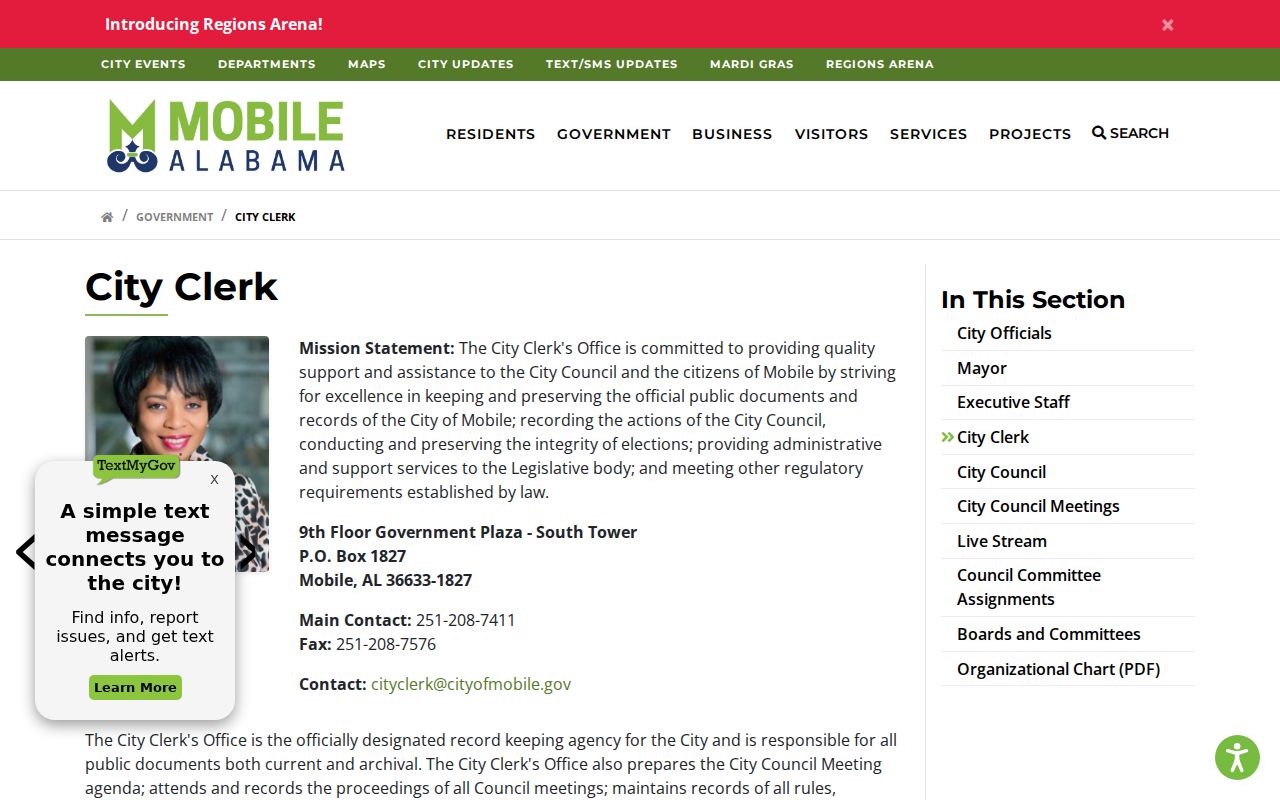
That gateway separates current city records from older material transferred to Municipal Archives.
Search Mobile Property Records
The Mobile County Revenue Commission portal has Owner, Address, ID, and Advanced modes. An owner search accepts a first or last name alone according to the form hint. Address search can use street number and street name. Advanced fields add Key Number, Owner ID, Parcel Number, property type, tax year, agent, business name, neighborhood, and appeal-related fields. A parcel is the mapped unit of land used by the tax and deed systems.
| Property field | Best use | Format note |
|---|---|---|
| Owner Name | Find a parcel tied to a person | First or last name may be used alone |
| Street Number and Name | Identify a specific site | Use a simple street name first |
| Key, Owner, or Parcel Number | Return to a known record | Use the identifier shown by the portal |
| Neighborhood | Narrow an advanced search | Uses a separate searchable selector |
Read the physical site, called the situs address, separately from the owner's tax mailing address. A different mailing address can help locate an absentee owner, but it does not prove who occupies the Mobile parcel. The portal also warns that appraisal information is not a legal conveyance.
Open the Mobile County property search before reviewing the captured owner and address modes.
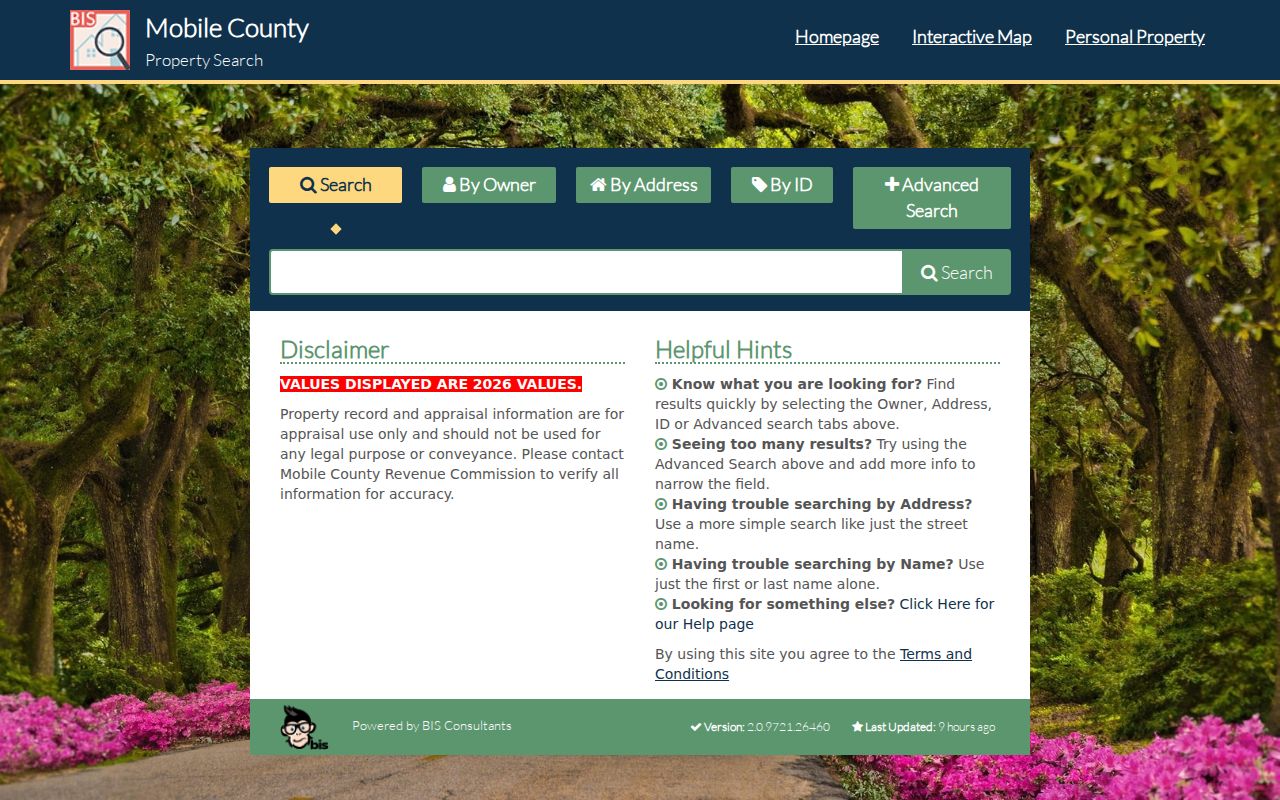
The screen is the practical first stop for a present parcel, not proof of every resident at that address.
Follow Mobile Deed Directory Clues
Mobile County Probate's Landmark WEB reaches real-property records from 1813 forward and searches more than five million documents. The modern index begins in 1984. Online images begin in September 1995. Index registration is free, images cost $0.10 per page, and an image stays available to print or download for ten days. A high-volume plan costs $125 per month. The free index and paid image answer different questions.
| Access level | What it supplies | Important limit |
|---|---|---|
| Courtesy index | Party role, date, book, page, or instrument trail | Not the official instrument |
| Online image | Recorded document and legal description | Generally September 1995 forward |
| Records Room | Older official instruments and public terminals | Weekdays, 8 a.m. to 5 p.m. |
Grantor means the seller or transferring party. Grantee means the buyer or receiving party. To move backward, find the current owner's purchase deed, take the seller's name, then search that seller as an earlier grantee. Carry the parcel and legal description because a street number can change.
Records-room tip. An online index hit may still require the second-floor Records Room for the older official instrument.
Probate explains the Landmark coverage and access choices shown in its records-search overview.
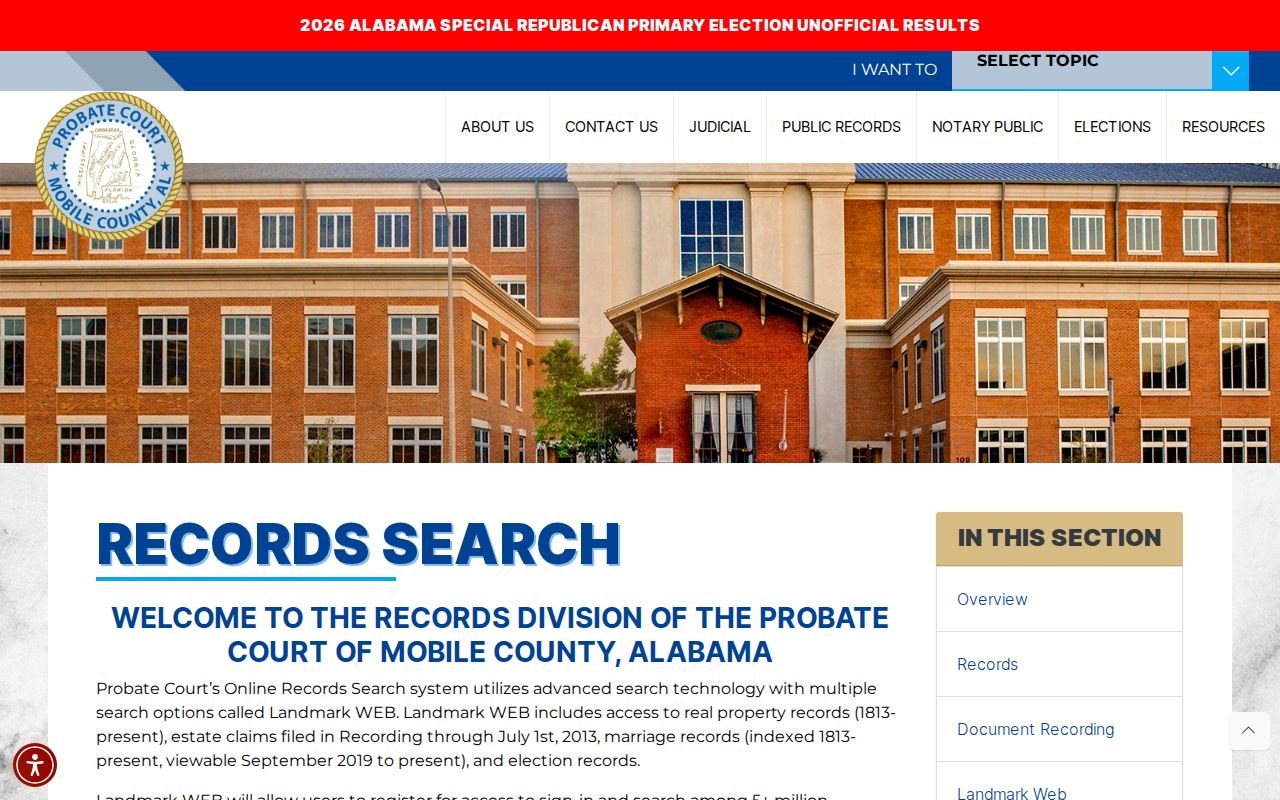
The overview makes the cutoff between a searchable reference and an available document image easier to see.
Mobile Voter Lookup Boundaries
Alabama VoterView verifies one voter through first name, last name, date of birth, and reCAPTCHA. It can confirm registration status and provide polling-place or ballot information. It is not a public street roster. Alabama also does not register voters by party, and participation history never reveals a ballot choice.
A separate voter-list request exists under Ala. Code §17-4-38. Electronic data costs $0.01 per voter with no minimum or added field charge and may be delivered in ASCII or Excel. Printed data costs $1 per page. Protected-voter rules matter: an accepted domestic-violence affirmation and certain qualifying official protections omit or redact residential and mailing addresses from public data.
A no-match has several possible causes. Input error, a move, inactive or cancelled status, and protected data can all affect the result. VoterView therefore supports a known-person check, but it cannot by itself establish nonresidence.
Note: The Board of Registrars counter is in Room 165 at 151 Government Street and operates weekdays from 8:30 a.m. to 4:30 p.m.
Check Mobile Court Records
The Mobile County Thirteenth Judicial Circuit covers Circuit and District courts. Its Circuit Clerk keeps Civil, Criminal, Domestic, Child Support, Traffic, Juvenile, and Warrant files. The statewide Just One Look system searches Criminal, Civil, Small Claims, State Traffic, Domestic Relations, and Child Support cases by name or case number. Each $9.99 search includes one case detail. More case detail costs $9.99, while available images cost $5 for the first 20 pages and $0.50 for each added page.
A result may include settings, actions or rulings, party details, a case action summary, financial data, and images. A docket is the court's chronological case record. A disposition is the recorded outcome. The online account is only one channel. Circuit Criminal accepts a detailed search and copy form by mail or for pickup, with a stated minimum of two weeks. The counter is Room C-927 in Government Plaza's North Tower.
Does a blank search prove there was no case? No. Sealed, expunged, juvenile, adoption, and Youthful Offender records may be absent from public results.
Municipal Court is a different desk for city-limit misdemeanors. Federal cases in Mobile belong to the Southern District of Alabama and PACER. Matching the court to the case type avoids treating a search gap as a factual answer.
Request Mobile Records Offline
Portals do not hold every Mobile record. Alabama's Open Records Law, Ala. Code §§36-12-40 to -47, gives Alabama citizens an inspection and copy right subject to exceptions. The 2024 procedure allows use of the custodian's published method or a hand-delivered or mailed request. Proof of Alabama residency may be required.
For a simple request, the statute sets an acknowledgment target within ten business days and a substantive response target within another fifteen business days. Extensions may run in fifteen-business-day increments. A request that exceeds eight staff hours is time-intensive. Judicial offices are not covered by all of those new timing rules, so a court copy request follows the clerk's own process.
- Name the exact office and record series.
- Give a narrow person, parcel, case, or date range.
- Choose inspection, ordinary copy, or certified copy.
- Include the contact and delivery details required by that custodian.
- Keep the acknowledgment and any extension notice.
For current municipal files, the City Clerk form asks for a reasonably definite description and a delivery preference. Routine city copies cost $0.25 per page, difficult retrieval can add research charges, and certification costs $5. Older municipal boxes are handled by Municipal Archives at 457 Church Street, where most processed records open after registration.
Current Mobile Directory Sources
No current Mobile directory covers the full population. Official sources list people because they own property, register to vote, become a party to a recorded instrument or court file, serve as an entity officer or agent, hold a license, or have unclaimed property. The source's purpose defines what a hit can prove.
| Mobile source | People represented | Custodian | Access route |
|---|---|---|---|
| Property roll | Parcel owners | Revenue Commission | Free owner and address portal |
| Land records | Parties to recorded instruments | Probate Court | Free index, paid images, counter |
| Voter verification | One registered voter | Secretary of State | Name, birth date, and challenge |
| Court index | Public case parties | Circuit Clerk | Paid portal or copy request |
| Business entities | Agents, officers, and incorporators where filed | Secretary of State | Public entity search |
| Unclaimed property | Names with a limited last-known location clue | State Treasurer | Free official search |
The Alabama business entity search offers Entity Name, Entity Number, Officer/Agent/Incorporator, and Reservation/Registration ID routes.
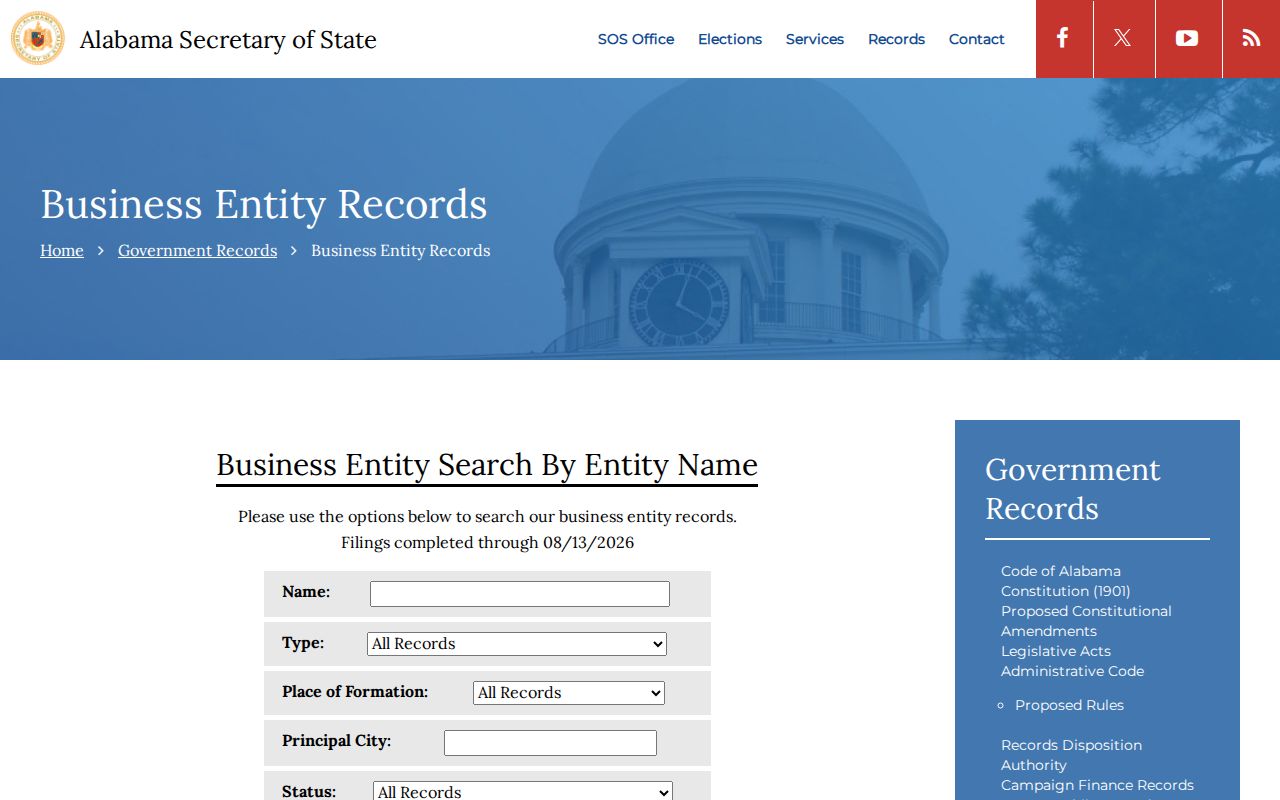
An entity result can support a Mobile business connection, but it is not a household directory or proof of a current home address.
Build a Mobile Heir Trail
Estate research often needs several Mobile sources in sequence. Probate's judicial index, wills, estate claims, an obituary, and a later deed may identify relatives and show how an interest moved after death. A property record alone names an owner, not every heir. An obituary can supply family relationships and a terminal date, while the recorded deed or probate file supplies the official transaction or proceeding.
The Mobile Public Library's newspapers begin on microfilm in 1819, and the Mobile Beacon run begins in 1959. Municipal burial reports can record name, sex, age, race, cemetery, and mortuary. Magnolia Cemetery deed and purchaser registers add family-lot context. These are especially useful when a death certificate is restricted or the statewide record series has not yet begun.
For birth-parent research, use Alabama Department of Public Health pre-adoption and sealed-file procedures. Do not infer an identity from records that are legally restricted. For classmates, the library's yearbooks and digital collections provide a more direct and appropriate trail.
Mobile Directory Privacy Limits
Public access does not make every field open. Alabama birth certificates remain restricted for 125 years and death certificates for 25 years. Adoption, mental-health commitment, juvenile, Youthful Offender, and expunged files have separate limits. Probate redacts Social Security numbers and birth dates to the extent allowed, while its online marriage data omits birth dates and mothers' maiden names.
Alabama enacted the Personal Data Protection Act in April 2026, now Ala. Code chapter 8-44, but its consumer rights do not take effect until May 1, 2027. The act is enforced by the Attorney General and does not erase original courthouse or assessor records. Voter address protections under §17-4-33 are a separate, record-specific mechanism.
Lawful use. Mobile public records may be used for legitimate personal research, but never to stalk, harass, threaten, impersonate, or harm another person.
Commercial people-finder products can merge stale feeds or same-name people and charge for results. Official indexes are better for source context, though they too have limits. Confirm important findings with the custodian rather than treating a compiled profile as an official record.
Browse Mobile Historical Directories
Mobile city directories begin in 1837, decades before mandatory statewide vital registration. The first known volume arranged heads of families and people in business by name. Later editions can show surname, given name, spouse, widow notation, occupation, employer, and residence address. A reverse or criss-cross directory changes the order, letting an old address lead to a listed occupant.
Mobile Public Library's Local History and Genealogy division keeps city directories, telephone books, yearbooks, maps, newspapers, church material, death and burial sources, immigration indexes, oral histories, and probate or municipal records. The Alabama Department of Archives and History finding aid lists dense runs from the nineteenth century through 2007, though a missing year in that aid means only that it is not listed there.
- Directory index
- An alphabetical key from a name to an entry.
- Criss-cross directory
- A volume arranged by street and address rather than surname.
- Parcel
- The mapped land unit linking the property roll, GIS, and deed trail.
- Certified copy
- A copy authenticated by the office holding the record.
The Local History and Genealogy service is at 753 Government Street and operates Monday through Saturday from 9 a.m. to 5 p.m.
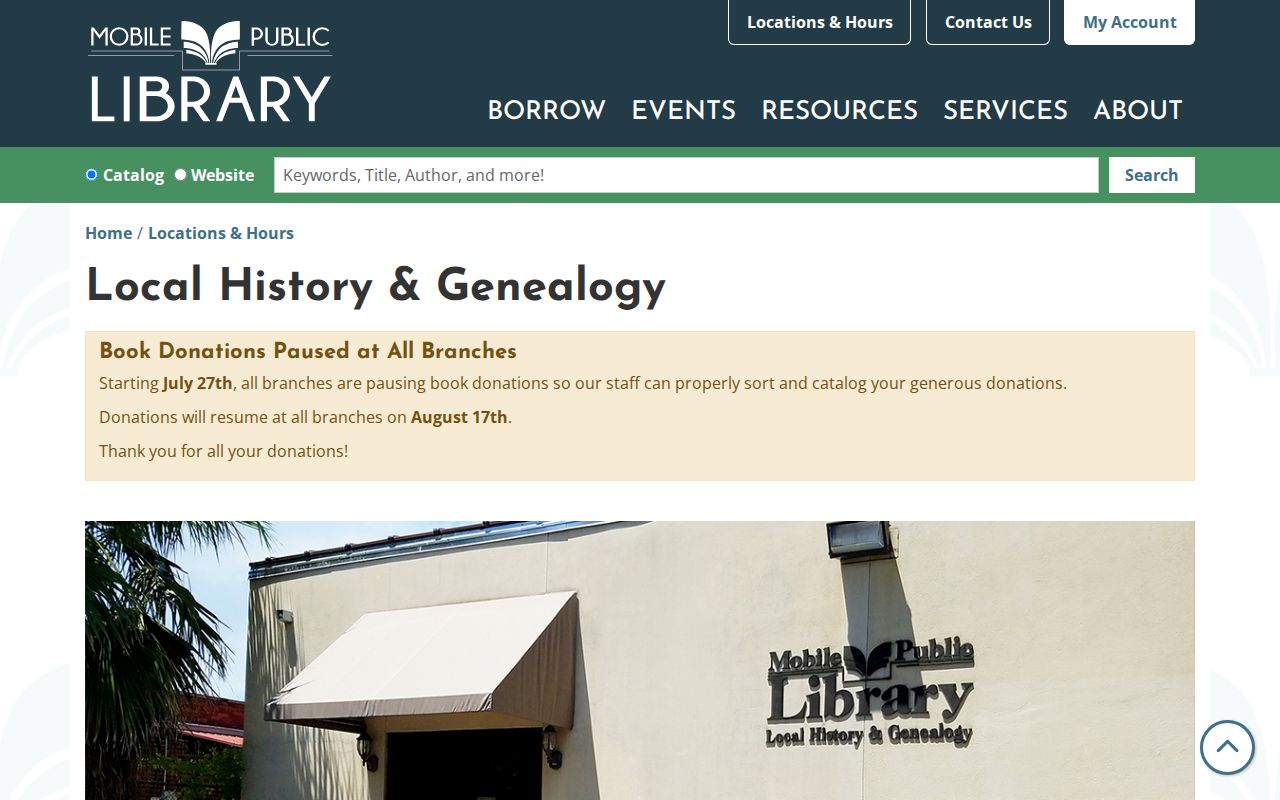
The collection bridges directory entries with microfilm newspapers, church records, yearbooks, and local death material. The full shelf and year method appears in the Mobile city directory collections.
Mobile's Unusual Resident Registers
Ordinary directories are not Mobile's only named sources. Probate's archives include a Dog License Book for 1888 to 1926, a Boat Book for 1895 to 1897, Child Labor Affidavits for 1908 to 1914, women's voter lists for 1920 to 1921, a naturalization index for 1833 to 1871, and poll-tax books for 1901 to 1970. Each is narrow, but a narrow register can solve a gap that a broad name search cannot.
The municipal archive adds tax and license lists, police and fire history, cemetery series, maps, and departmental correspondence. Church registers and Gulf Coast religious archives help before statewide vital registration. Port, railroad, shipbuilding, Mardi Gras, military, and maritime groups also left names in newspapers and organizational publications.
Use the register's date and purpose as evidence boundaries. A dog-license entry can place a named person in a time-bounded civic record. It does not prove a complete household. A women's voter book or poll-tax book reflects the rules and population recorded in that era, not all Mobile residents.
How Mobile Records Went Digital
Mobile's public record trail is unusually deep. U.S. municipal records begin in 1814, Probate citizen records in 1812, and land books in 1813. Colonial originals from 1702 to 1813 are dispersed mainly among European archives. Probate staff later found colonial and historical records in the courthouse attic, which helped lead to an Archives Section in 1989.
Access changed in stages. State-assisted microfilming began in 1948. Probate created its in-house micrographics section in 1958, reached certified-lab status in 1992, began scanning and web access in 2000, added electronic recording in 2014, and completed digitization of its microfilm and direct-reverse indexes in 2019.
Those dates explain why one Mobile residents directory search may span a web form, a paid image, a microfilm index, and a physical instrument. Digital access is broad, but the older official source still controls.
Note: Mobile's record history rewards a mixed search, since the oldest useful resident evidence predates both modern addresses and statewide certificates.