
Mobile City Directory Shelf
Mobile has several complementary directory shelves rather than one complete online run. The Mobile Public Library Local History & Genealogy division states that its holdings reach back to 1837. The Alabama Department of Archives and History, or ADAH, lists many precise years in microfiche and bound form. The University of South Alabama's Doy Leale McCall Rare Book and Manuscript Library reports a 1837–2001 span with missing years. A gap in any one catalog means that volume is not listed there; it does not prove the directory was never printed.
| Collection | Years documented | Where held | Access route |
|---|---|---|---|
| Mobile historical volumes | Back to 1837 | Mobile Public Library Local History & Genealogy | Onsite inquiry and staff help |
| State directory inventory | 1837–2007, with listed gaps | Alabama Department of Archives and History | Microfiche, bound and boxed volumes |
| University directory run | 1837–2001, with missing years | Doy Leale McCall Library | Print for most twentieth-century years; microfilm for nineteenth-century years |
| Digital local collections | Item-level coverage varies | Mobile Public Library Digital Collections | Free online keyword and advanced search |
The first call should match the era. MPL is the practical local starting desk. ADAH supplies a detailed statewide inventory, while McCall offers another long Mobile run and related probate, court, marriage, and naturalization sources. This overlap helps when a reel is hard to read or a year is absent from one institution.
The Mobile Public Library directory page documents the early reach of the local collection.
That collection notice makes the library, not a broad commercial index, the sound first stop for the oldest local editions.
Mobile's First Known Volume
Mobile's known directory story begins early. The 1837 volume was titled Mobile Directory, Embracing Names of the Heads of Families and Persons in Business, Alphabetically Arranged, for 1837. H. M. McGuire and Thomas C. Fay compiled it, and R. R. Dade printed it. An 1855/56 title included firms, members of firms, householders, and freeholders. Farrow & Dennett issued an 1859 Mobile City Directory. A 1920 catalog record confirms Polk's Mobile City Directory, but the research does not establish an exact start or end for Polk's run. It would be inaccurate to call every year a Polk directory.
This start date matters. Mobile's printed volumes predate statewide mandatory birth and death registration in 1908 by decades. For a nineteenth-century household, an address, trade, or spouse notation may create the bridge between deeds, church registers, cemetery records, and newspapers. The entries are not a census and may omit many residents, yet their near-annual rhythm can show change that ten-year federal schedules miss.
- 1837: McGuire and Fay compile the first known Mobile volume documented in the research.
- 1855/56: A directory title covers firms, firm members, householders, and freeholders.
- 1859: Farrow & Dennett publishes a named Mobile directory.
- 1920: A catalog record verifies a Polk's Mobile City Directory title.
- 2007: The later ADAH inventory reaches July 2007, without proving a continuous annual run.
Note: The 1960 census is scheduled for release in 2032, so directory editions remain vital for the years after 1950.
Mobile Directory Runs at ADAH
The ADAH finding aid gives the clearest year-by-year view. Its microfiche entries include 1837, 1838, 1839, 1842, 1844, 1855, 1856, and 1859. Bound or boxed holdings include 1837, 1839, 1842, 1850–52, 1855, 1859, 1861, 1866–67, 1869–1903, 1905–16, 1918, 1920, 1922, 1924, 1926–33, 1935–42, 1944–56, 1958–69, 1971–92, 1995, 1997, 2000–03, and 2005–07. The later holdings include a Mobile–Baldwin Counties volume for 1997 and two volumes for 2006.
Those dates should be used as an inventory, not a claim of seamless yearly publication. Ask staff for the exact format and call information before travel. The ADAH research guidance also explains its onsite genealogy resources and county-record microfilm.
The state archive becomes especially useful when a Mobile library copy is missing, damaged, or surrounded by related county material.
Read a Mobile Directory Entry
An entry is compact, and its symbols change by publisher and year. Start by photographing or noting the volume's abbreviation key. A typical listing may give a surname and first name, place a spouse in parentheses, mark a widow, state a trade or employer, and give a house number and street. Some editions may include a homeownership symbol. Because a readable sample entry was not captured in the research, each mark must be checked against the exact Mobile volume rather than decoded from a rule borrowed from another city.
| Name | Usually surname first, with initials or shortened given names possible |
|---|---|
| Spouse or widow mark | A family link that must be read with that edition's key |
| Trade or employer | A clue to port, rail, shipbuilding, retail, or other community records |
| Residence | The listed house number and street at publication time |
| Homeownership symbol | Present in some runs, but never assume a mark without checking the key |
- Criss-cross directory
- A later directory section arranged by street and house number rather than by surname.
- Householder index
- A list centered on the person identified as the household's principal listed resident, not every person at the address.
- Abbreviation key
- The publisher's legend for shortened words, occupations, spouse marks, and address codes in that edition.
A directory line is evidence of a listing at one point in time. It does not establish every household member, exact move dates, or legal ownership. Compare it with a deed, census, newspaper, or death record before drawing a firm conclusion.
Search MPL Collections
The Mobile Public Library Digital Collections search can reach yearbooks and local-history items that sit beside directory research. Its form accepts query text and offers Keyword, Boolean, or Exact Match modes. A search may be limited to an Item, File, Collection, or Exhibit, while Advanced Search narrows item-level results. Named collections include Mobile Death Records and the City Atlas of Mobile. The portal does not promise that every directory year is digitized, so a failed web search should lead to the local-history desk rather than end the inquiry.
Open the Mobile Public Library Digital Collections and test name variants, initials, a street, and an organization tied to the person.
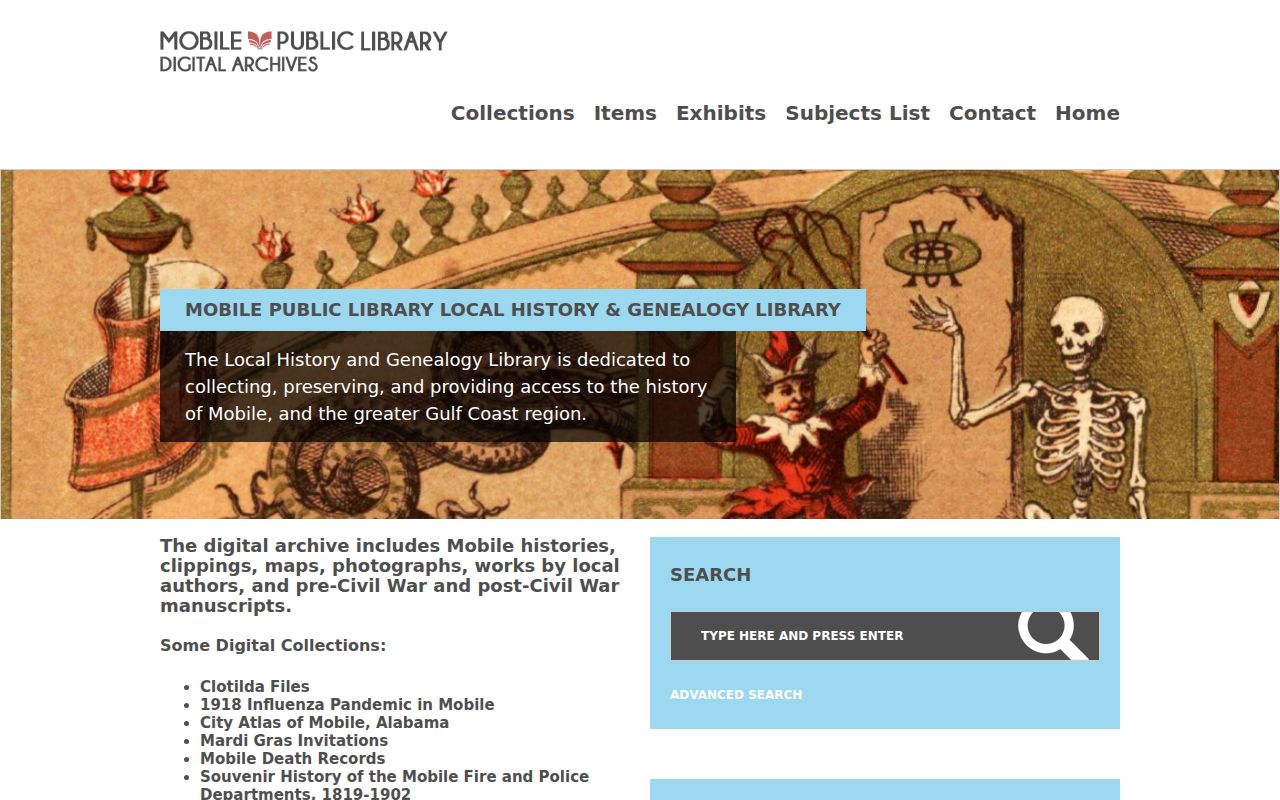
The visible collection search is most useful as a companion index. It can connect a printed name to a class photograph, atlas, death record, or other digitized local item.
| Search control | Available choice | Best Mobile use |
|---|---|---|
| Query text | Name, address, group, or phrase | Begin broad, then retry initials and spelling variants |
| Match mode | Keyword, Boolean, Exact Match | Use Exact Match only after confirming the printed form |
| Scope | Item, File, Collection, Exhibit | Narrow a large result set without assuming full directory coverage |
| Advanced Search | Item-level filters | Pair a name with a yearbook or local-history collection |
Mobile City Directory Research Desks
The strongest access plan uses all documented channels. Mobile Public Library Local History & Genealogy is at 753 Government Street, open Monday through Saturday from 9 a.m. to 5 p.m. Staff can be reached at 251-494-2190 or mainlhg@mplonline.org. Its readers can print, email, or scan microfilm images. The collection also includes telephone books, maps, oral histories, church material, immigration indexes, yearbooks, and newspapers.
The Doy Leale McCall Library is at 5901 USA Drive North, Suite 300. Call 251-341-3900 or write mccalllib@southalabama.edu before visiting. ADAH is the state-level fallback for the itemized directory run and related microfilm. When the question concerns surviving city government records rather than a printed directory, the Mobile Municipal Archives at 457 Church Street is open weekdays from 8 a.m. to 5 p.m. and can be reached at 251-208-7740.
Mobile Public Library
Local city directories, microfilm newspapers, yearbooks, maps, church and death material.
McCall Library
A long directory run plus marriage, naturalization, probate, court, and land-index material.
ADAH
Detailed Mobile directory inventory in microfiche, bound, and boxed formats.
Municipal Archives
Processed city records, licenses, tax lists, maps, minutes, and department files.
Note: Call ahead with a target surname, year range, and street so staff can identify the best format before a visit.
Trace Families in Mobile Directories
A careful trace follows both the person and the place. French and Spanish influence, shortened given names, and Anglicized spellings make variants essential in Mobile. Port work, military service, maritime trades, railroads, shipbuilding, and Mardi Gras groups may also explain why a person appears in an occupational or organization source but not under the expected home address.
- Find the earliest likely alphabetic entry. Record the printed name, spouse, trade, employer, address, and every abbreviation.
- Check the edition before and after it. Note the first appearance, each address change, and the last listing without treating a missing year as a death.
- When available, switch to the street-order or criss-cross section. Compare other listed householders at the same address and nearby numbers.
- Pair 1940 and 1950 directory observations with the released federal census schedules. Use deeds and probate sources to bridge other years.
- If the name vanishes, search newspapers, death material, cemetery records, and probate. Those sources may show a move, death, heir, or name change.
For a modern address-keyed search rather than a historical shelf trace, the Mobile street directory follows parcels and current public records. The two methods meet at the address but answer different questions.
Companion Records Beyond Volumes
Mobile newspapers on library microfilm begin in 1819, and the Mobile Beacon begins in 1959. A notice may connect an address with relatives, a club, a firm, or a funeral. Library death certificates cover 1876–1908. Church registers can help bridge years before statewide vital registration, especially within Mobile's Catholic and Gulf Coast religious history. Yearbooks from MPL and the University of South Alabama are useful for classmates and institutional ties.
Municipal and probate sources add less obvious clues. City archive holdings include tax and license lists, departmental correspondence, maps, and cemetery series. Probate preserves naturalization, voter, census, poll-tax, and other historical books. These sources can confirm that a similar name belonged to the same Mobile resident, but each record must be read within its own date and purpose.
- Use an obituary for relatives and a terminal date.
- Use a census for the household recorded on census day.
- Use a deed for legal ownership, not a full resident list.
- Use a church or cemetery record for an event the directory omits.
- Use a yearbook for school identity and name variants.
When Mobile Directories Go Silent
A missing listing has several possible causes. The resident may have moved, died, changed names, been left out, or appeared under an abbreviation. The volume itself may be absent from one catalog. Street names and numbers can change, and postal Mobile reaches beyond the municipal line. An address should therefore be checked against an atlas, parcel description, later reverse directory, or city record before two listings are treated as different places.
There is another myth worth avoiding: printed directories never captured all residents. They often centered on householders, people in business, and listed telephone customers, depending on the era. Private rosters also remain private unless their keeper publishes them. A no-hit is a prompt to change sources, not proof that a person was absent from Mobile.
Mobile's unusual archives can rescue a stalled trail. Dog-license books, women's voter lists, poll-tax books, a boat book, child-labor affidavits, and cemetery registers preserve time-bounded evidence outside the ordinary printed volumes. Use these records as dated clues and confirm the identity with at least one independent source.